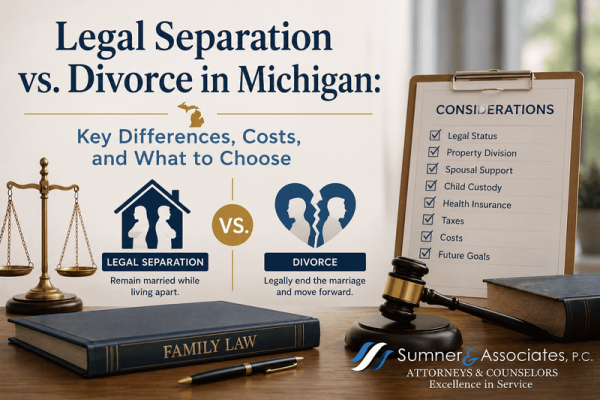
If you are considering ending your marriage in Michigan, you may be weighing two options: legal separation or divorce. While both processes address issues like property division, child custody, and support, they lead to very different outcomes.
Understanding the differences between legal separation and divorce is essential before making a decision that will impact your finances, your family, and your future.
If you are just beginning to explore your options, it can be helpful to understand how the divorce process works step by step. You can review the full process in Steps to File for Divorce in Rochester Hills, Michigan to see how a divorce case progresses in Michigan.
What Is Legal Separation in Michigan?
In Michigan, what is commonly referred to as “legal separation” is officially called separate maintenance.
Separate maintenance allows spouses to live apart and resolve key legal issues without ending the marriage. This means you remain legally married but operate under a court-approved agreement.
A separate maintenance case can address:
-
- Division of property and debts
-
- Child custody and parenting time
-
- Child support
-
- Spousal support
However, unlike divorce, legal separation does not terminate the marriage.
What Is Divorce in Michigan?
A divorce legally ends the marriage and allows both parties to remarry.
Like legal separation, divorce resolves:
-
- Property division
-
- Child custody
-
- Support obligations
But once the court issues a Judgment of Divorce, the marriage is officially dissolved.
If you are considering divorce, understanding the full process—from filing to final judgment—is critical. The steps are outlined in detail in Steps to File for Divorce in Rochester Hills, Michigan.
Key Differences Between Legal Separation and Divorce
While the two processes are similar in structure, their outcomes differ significantly.
Marital Status
-
- Legal Separation: You remain legally married
-
- Divorce: The marriage is legally ended
Ability to Remarry
-
- Legal Separation: You cannot remarry
-
- Divorce: You are free to remarry
Religious or Personal Considerations
Legal separation is sometimes chosen for religious reasons where divorce is discouraged.
Financial and Legal Ties
Legal separation maintains certain legal ties, while divorce fully separates the parties.
Understanding these differences is critical when deciding which option aligns with your goals.
Why Some Couples Choose Legal Separation
Legal separation may be appropriate in certain situations.
1. Religious Beliefs
Some couples prefer separation due to religious views that discourage divorce.
2. Financial Reasons
Remaining married may allow spouses to:
-
- Maintain health insurance coverage
-
- Retain certain tax benefits
3. Time to Decide
Legal separation can provide space to determine whether reconciliation is possible.
4. Stability for Children
Some parents believe legal separation offers a more gradual transition for children.
While these benefits can be meaningful, it is important to understand the limitations as well.
Why Most People Choose Divorce
In most cases, individuals ultimately choose divorce over legal separation.
1. Finality
Divorce provides a clear legal end to the marriage.
2. Financial Independence
Divorce allows each party to fully separate their financial lives.
3. Ability to Move Forward
Divorce allows individuals to remarry and fully move on.
4. Fewer Long-Term Complications
Legal separation can sometimes create ongoing legal and financial entanglements.
Because of these factors, divorce is often the more practical long-term solution.
Can Legal Separation Turn Into Divorce?
Yes. A separate maintenance case can be converted into a divorce if one spouse decides to proceed.
If either party files for divorce, the court will typically move forward with the divorce process instead of maintaining the separation.
This means that legal separation may not provide a permanent alternative if one spouse wants a divorce.
The Legal Process: Separation vs Divorce
The process for legal separation is very similar to divorce.
Filing
Both require filing a complaint with the court.
Service
The other spouse must be formally served.
Negotiation and Disclosure
Both involve financial disclosures and negotiation of terms.
Court Orders
Temporary and final orders are issued in both cases.
The key difference is the final outcome—legal separation does not end the marriage.
To understand how these steps unfold in a divorce case, refer to Steps to File for Divorce in Rochester Hills, Michigan.
Costs of Legal Separation vs Divorce
Costs for both processes can vary depending on the complexity of the case.
Legal Separation Costs
-
- Similar filing fees to divorce
-
- Attorney fees for negotiation and court proceedings
Divorce Costs
-
- Comparable to legal separation
-
- May involve additional costs if litigation is required
In many cases, legal separation does not provide significant cost savings compared to divorce.
Child Custody and Support Considerations
Both legal separation and divorce require decisions about children.
Courts will address:
-
- Legal and physical custody
-
- Parenting time schedules
-
- Child support obligations
In both cases, decisions are based on the best interests of the child.
Because these decisions can have long-term consequences, it is important to approach them carefully regardless of which option you choose.
Property Division and Financial Impact
Property division is handled similarly in both processes.
Michigan follows an equitable distribution approach, meaning assets are divided fairly but not necessarily equally.
Both legal separation and divorce require:
-
- Full financial disclosure
-
- Identification of marital and separate property
-
- Allocation of debts
However, legal separation may leave certain financial ties intact, which can create complications later.
Health Insurance and Benefits
One of the most common reasons couples consider legal separation is to maintain health insurance coverage.
In some cases:
-
- A spouse may remain on the other’s insurance plan during separation
-
- Divorce may terminate eligibility for coverage
However, insurance policies vary, and it is important to verify coverage details before making a decision.
Tax Implications
Legal separation and divorce can have different tax consequences.
Legal Separation
-
- You may still file taxes jointly in some cases
-
- Certain benefits may remain available
Divorce
-
- You must file separately or as head of household
-
- Tax implications may change significantly
Consulting with a financial professional can help you understand the impact on your situation.
Emotional Considerations
Beyond legal and financial factors, emotional considerations play a significant role.
Legal separation may:
-
- Provide time for reflection
-
- Reduce the immediate emotional impact
Divorce may:
-
- Offer closure
-
- Allow individuals to move forward more fully
There is no one-size-fits-all answer. The right choice depends on your personal circumstances and goals.
Common Misconceptions
“Legal separation is easier than divorce”
Not necessarily. The legal process is very similar.
“Legal separation avoids court”
Both processes typically involve court proceedings.
“Legal separation is permanent”
It can be changed if one spouse files for divorce.
Understanding these realities helps prevent unexpected outcomes.
When Should You Consider Legal Separation?
Legal separation may be worth considering if:
-
- You have strong religious objections to divorce
-
- You want to maintain certain financial benefits
-
- You are not ready to fully end the marriage
However, it is important to weigh these factors carefully.
When Divorce May Be the Better Option
Divorce is often the better choice if:
-
- You want a clean legal break
-
- You plan to remarry in the future
-
- You want to fully separate finances
-
- There is no intention of reconciliation
For many individuals, divorce provides greater clarity and long-term stability.
Making the Right Decision for Your Future
Choosing between legal separation and divorce is a significant decision.
It affects:
-
- Your legal status
-
- Your financial future
-
- Your family dynamics
Taking the time to understand your options—and how each process works—can help you make the best choice.
If you are leaning toward divorce, reviewing the full process in Steps to File for Divorce in Rochester Hills, Michigan can give you a clear understanding of what to expect.
Take the Next Step With Confidence
There is no single solution that works for every situation. The right path depends on your goals, your circumstances, and your long-term plans.
Whether you are considering legal separation or divorce, having the right information is the first step toward making a confident decision.
At Sumner & Associates, P.C., we help clients evaluate their options and move forward with clarity and efficiency.
Schedule your confidential consultation today.